Landscapes
Geography
How Spain's post-1978 constitutional settlement shaped 17 distinct administrative territories, each with its own government, geographic character, and cultural policy.

Spain's transition to democracy following Francisco Franco's death in 1975 culminated in the Constitution of 1978, which established a decentralised state model known as the Estado de las Autonomías. The text did not prescribe a fixed number of regions but provided a framework through which territories could negotiate autonomy statutes with the central government.
By 1983, the process had produced 17 autonomous communities, each with its own parliament, executive, and competencies over areas including education, health, policing, and urban planning. Two cities — Ceuta and Melilla on the North African coast — hold a separate status as autonomous cities.
The model represented a deliberate break from the highly centralised administration of the Franco era while stopping short of a fully federal structure. Certain communities, notably the Basque Country and Navarre, retained historic fiscal arrangements (the fueros) that give their regional governments direct control over tax collection — an arrangement without equivalent elsewhere in Spain.
Key fact
The Basque Country and Navarre operate under a régimen foral (foral regime) in which regional tax authorities collect taxes directly and transfer an agreed quota to the central government, rather than the reverse arrangement that applies in other communities.
The communities vary substantially in land area and population. Castile and León is the largest by area, covering roughly 94,000 km² — larger than Portugal. The smallest, La Rioja, occupies around 5,000 km². Madrid, by contrast, is one of the densest communities with a relatively small geographic footprint.
| Community | Capital | Geographic zone | Co-official language(s) |
|---|---|---|---|
| Galicia | Santiago de Compostela | Atlantic northwest | Galician |
| Asturias | Oviedo | Atlantic north | Asturian (regional, no official status) |
| Cantabria | Santander | Atlantic north | Spanish only |
| Basque Country | Vitoria-Gasteiz | Atlantic north | Basque (Euskera) |
| Navarre | Pamplona | Northern plateau | Basque (in Basque-speaking zones) |
| La Rioja | Logroño | Ebro valley | Spanish only |
| Aragon | Zaragoza | Ebro valley / Pyrenees | Aragonese, Catalan (minor zones) |
| Catalonia | Barcelona | Mediterranean northeast | Catalan, Occitan (Val d'Aran) |
| Balearic Islands | Palma | Western Mediterranean | Catalan |
| Valencia | Valencia | Mediterranean east | Valencian (a variety of Catalan) |
| Murcia | Murcia | Mediterranean southeast | Spanish only |
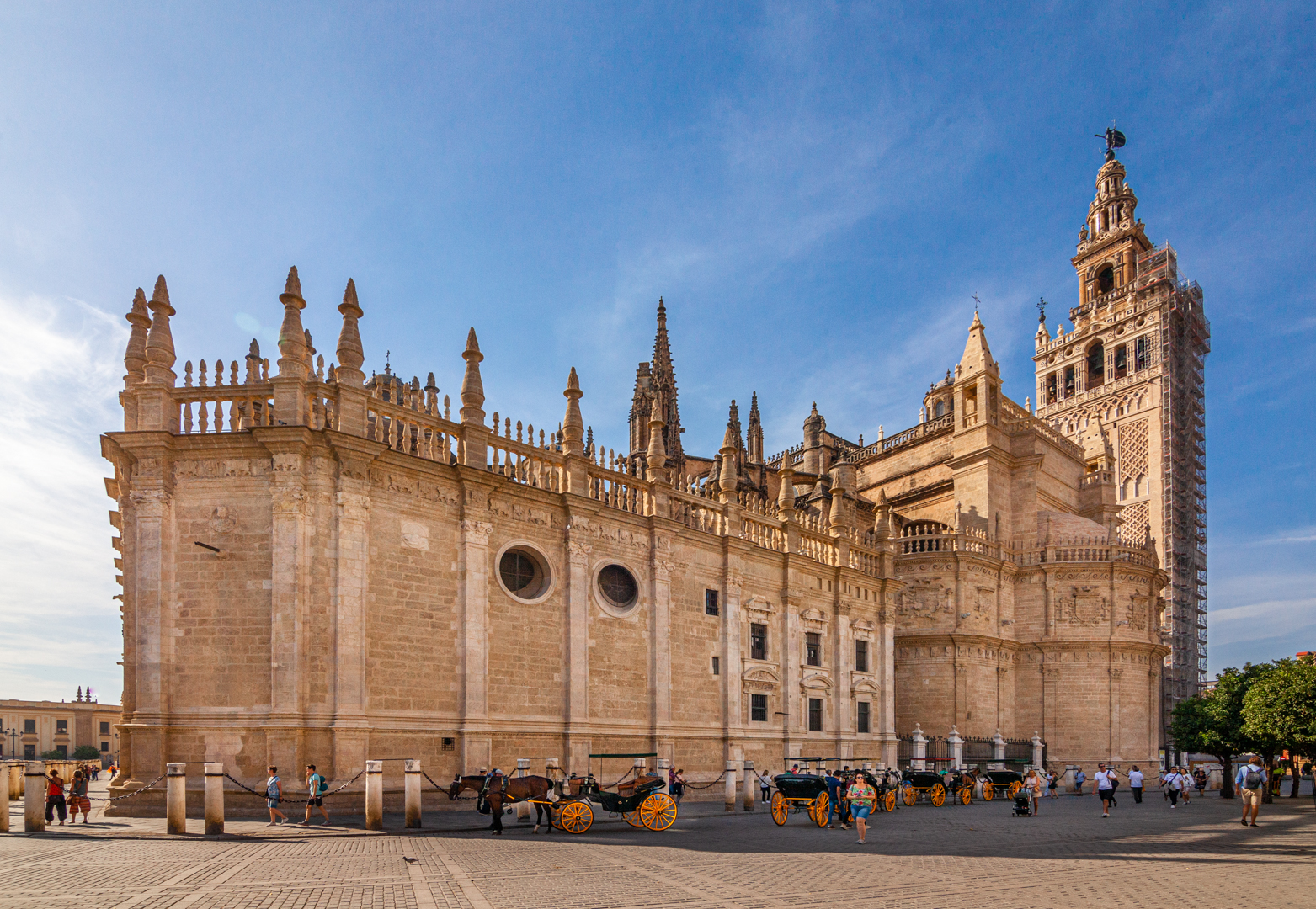
| Andalusia | Seville | Southern Iberia | Spanish only |
| Extremadura | Mérida | Western plateau | Spanish only |
| Castile-La Mancha | Toledo | Central plateau | Spanish only |
| Madrid | Madrid | Central plateau | Spanish only |
| Castile and León | Valladolid | Northern plateau | Spanish only |
| Canary Islands | Las Palmas / Santa Cruz | Atlantic archipelago (Africa) | Spanish only |
The central plateau, known as the Meseta Central, dominates the interior of the Iberian Peninsula. Sitting at an average elevation of around 660 metres, it is one of the highest plateau regions in Europe. The Meseta splits into a northern section (the Meseta Norte) drained by the Douro river system and a southern section (the Meseta Sur) drained by the Tagus and Guadiana.
This interior geography strongly influences Spain's climate: the coasts are moderated by the sea, while the interior experiences a markedly continental regime — hot dry summers and cold winters. The city of Madrid, at roughly 660 metres, experiences temperature swings that bear little resemblance to coastal cities like Valencia or Bilbao despite being on the same latitude.
Seven languages have co-official status in specific communities alongside Castilian Spanish: Catalan (Catalonia, Balearics), Valencian (Valencia), Galician (Galicia), Basque (Basque Country, parts of Navarre), Occitan in the Aranese variety (Val d'Aran, Catalonia), and Aragonese (with limited recognition in Aragon). Several others, including Asturian and Leonese, have regional recognition without full official status.
The linguistic map reflects the historical patchwork of kingdoms, counties, and caliphates that preceded the union of Castile and Aragon in 1479. Basque is particularly notable: its origins remain unclear and it predates the Indo-European languages that cover the rest of Western Europe.
"The territorial diversity of Spain is not merely administrative — it reflects genuine differences in ecology, history, and daily life that are immediately perceptible on the ground."
Two of Spain's autonomous communities are entirely archipelagic. The Balearic Islands in the western Mediterranean — Mallorca, Menorca, Ibiza, Formentera, and smaller islets — are geologically an extension of the Betic Cordillera mountain system. Catalan is the co-official language alongside Spanish.
The Canary Islands stand apart geographically. Located in the Atlantic Ocean roughly 100 kilometres from the northwest African coast, the seven main islands (Tenerife, Gran Canaria, Lanzarote, Fuerteventura, La Palma, La Gomera, El Hierro) are of volcanic origin and sit on the same latitude as southern Morocco. Their inclusion as a Spanish autonomous community reflects historical conquest rather than geographic proximity to the peninsula.
Under Spain's devolved system, communities have assumed varying levels of competency over transferred powers. Health services, primary and secondary education, policing (in the Basque Country and Catalonia, which have their own police forces), and social services are managed at the regional level in most communities. The result is that standards of provision, administrative procedures, and even public holidays can differ substantially from one community to another.
This variation extends to infrastructure investment decisions, regional development funds, and cultural promotion budgets — producing observable differences in regional economic trajectories that have remained a persistent subject of political debate within Spain.